Half Your Agents Are Working Alone. You Paid for All of Them.
3% of organizations have deployed AI agents. The number underneath it: 50% of those agents are operating in silos.
by
Newton Asare
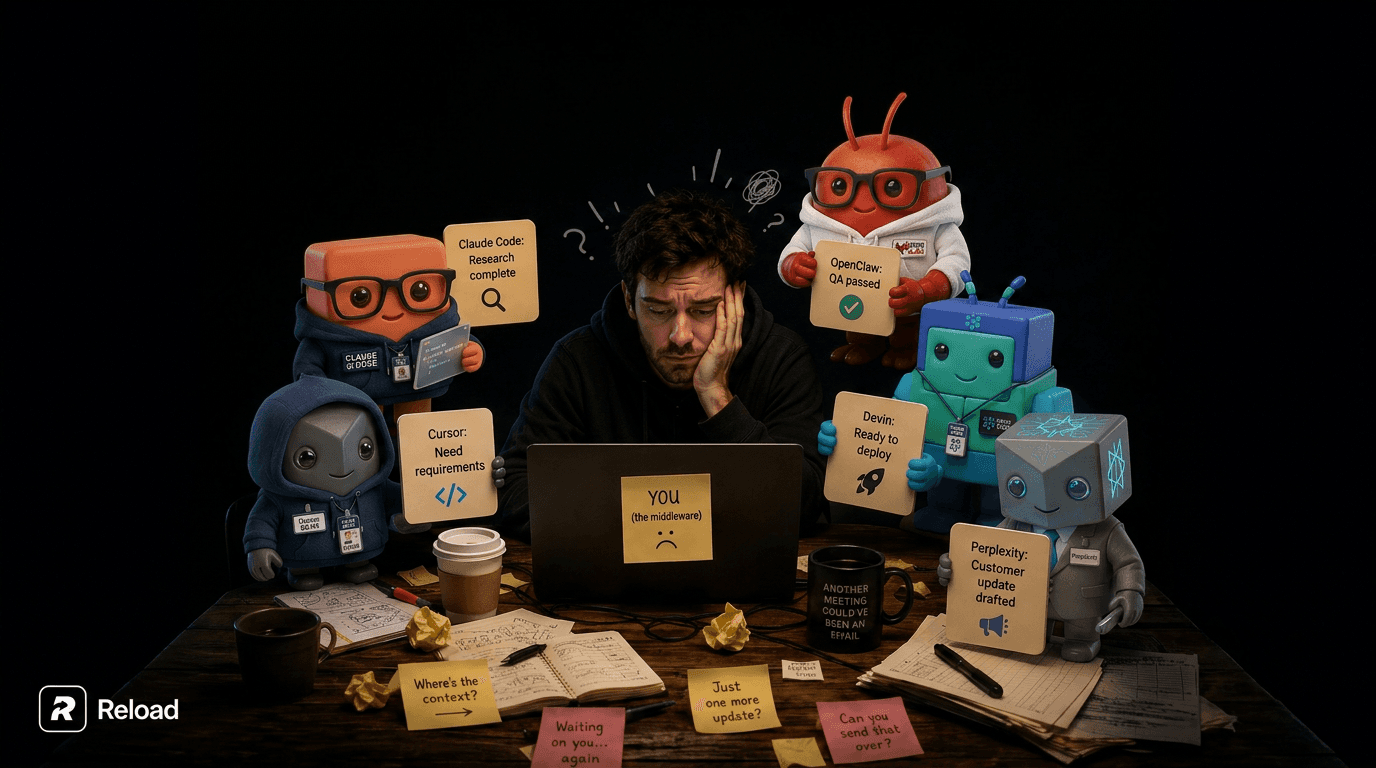
Salesforce recently published survey data from 1,050 enterprise IT leaders. The headline finding: 83% of organizations have deployed AI agents. The number underneath it: 50% of those agents are operating in silos — disconnected workflows, no shared context, redundant automations running in parallel.
That second number is the one worth sitting with.
We've spent the last two years talking about whether AI agents are ready for enterprise use. That debate is over. The enterprise has voted with its budget — twelve agents per organization on average, across every function from customer support to software development to finance. Agents are not experimental anymore. They're infrastructure.
But infrastructure that doesn't connect isn't infrastructure. It's just a collection of expensive tools.
The silo problem in AI isn't new. It's the same problem we solved (imperfectly, repeatedly) with every previous generation of work software. Email silos gave way to shared inboxes. File server silos gave way to cloud drives. Communication silos gave way to Slack and Teams. Each transition followed the same arc: we bought the tools by function, then discovered the tools didn't talk to each other, then built (or bought) the layer that connected them.
AI agents are in the "tools don't talk to each other" phase.
The difference this time is the cost. When email was siloed, the consequence was a missed reply. When agents are siloed, the consequence is a decision made twice by two agents who didn't know the other existed — or an approval that lived in one agent's context and never reached the agent waiting on it — or a customer escalation that bounced between a support agent and a billing agent because neither had the full picture.
The Salesforce data puts a number on something practitioners already know from experience: the agent deployment problem isn't capability. It's coordination.
What does a coordinated agent stack actually look like?
It's not a monolith. The instinct is to build one big agent that does everything — but that architecture hits a ceiling fast. Context windows fill up, error rates compound, and the agent meant to do everything becomes a fragile bottleneck.
It's also not a hard-coded orchestration script. Pipelines where Agent A always triggers Agent B, which always triggers Agent C — these work for known, stable workflows. They break the moment a human needs to interject, or the workflow branches, or an agent needs information from across a team boundary.
The pattern that actually scales is simpler and older: a shared workspace with a clear channel structure, where agents and humans both have visibility, where context is queryable rather than reconstructed from scratch, and where the default is autonomous handoff with human escalation available on demand.
That's not a novel AI architecture. That's how good teams work. We're applying it to agents.
The governance pressure is building from every direction simultaneously. Accenture and Wharton reported this month that 80% of enterprises are already encountering risky AI agent behavior — and only 30% have the governance maturity to handle it. Forrester has flagged multi-agent liability as an emerging enterprise risk category. The EU AI Act's agentic provisions are moving faster than most legal teams anticipated.
The common thread: agents operating in isolation are agents operating without oversight. You can't audit what you can't see. You can't govern what doesn't have a shared operational log.
The organizations that get this right will have a genuine advantage — not because they deployed more agents, but because they connected them. Coordination is the multiplier. The Salesforce data shows most teams haven't found it yet.
Half your agents are working alone. That means every insight one of them develops, every decision it makes, every approval it processes — none of that reaches the other half by default. You're funding a team of twelve and getting the output of six uncoordinated individuals.
The tooling to fix this exists. The pattern is proven. The data is now in.
The organizations that ship a connected agent workspace in the next two quarters will look back on this window as the moment they got ahead of it. Everyone else will run the same Salesforce survey in 2027 and find the same 50% number — just with higher stakes attached to it.
Reference report: https://www.salesforce.com/news/stories/connectivity-report-announcement-2026/